As of now, driverless cars cost more than regular cars because of the additional sensors and additional computer power needed to manage all these sensor’s data. It’s clear that the added cost will dwindle during the following years as driverless cars will become more “mainstream”.
This “driverless” added cost might, soon, not be so big anyway when considering a truck driven by a professional driver.
In a 1st step, a driver will have to be present, but the driverless functionality will be a great help for him. Legally, he might even be allowed to drive longer in the day, which would improve its productivity from its employer point of view. The overall balance between cost of driverless feature and improved productivity due to assisted driving would then very soon tilt in favor of driverless trucks.
In a ultimate step (step 3), a driver might not even be needed (technically and legally). At this stage we can expect driverless functionality to be well below a truck driver’s yearly cost.
Driverless trucks are most mature in Australia mines
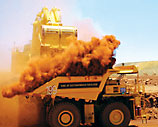
Before having driverless trucks on our road, they will arrive very soon or are already there in controlled environments such as mines. In these “closed” environments V2V or V2I technologies make sense as opposed to regular highway.
Typically in Australia where Rio Tinto is using some Komatsu’s driverless trucks and Autonomous Haulage System—Komatsu's Pioneering Technology Deployed at Rio Tinto Mine in Australia.
Talking about another mining project in South Australia from Iron Road Limited:
Despite all he has achieved, Mr Scholz (Wudinna’s mayor) realises without the mine Wudinna faces an increasingly difficult future. "They will have driverless tractors within 10 years and if the trend continues we won't be able to sustain our community," he said.
Truck driver might not be a job with a great future anymore.
Several car manufacturers work on driverless cars. They explore some different ways of doing it. Volvo is one of the most advanced exploring V2V technology. V2V is an acronym for vehicle-to-vehicle communication. It’s about using some dynamic vehicle to vehicle wireless communications to have cars get extra informations from neighbour cars or from sensors on the road itself.
But Do driverless cars need V2V communication?
To establish communication, you need to be at least 2 and share a common way to communicate. There are plenty of road stakeholders with which V2V communication will not be possible. Even if all vehicles shared the same way of communicating, the wild boar crossing the road in front of your car will not be able to communicate with your driverless car, at least not in a wireless way.

And as a matter of fact, today, most the google car and the soon to be released new Mercedes do not rely on V2V but only or mostly on their sensors.
If V2V is to have a future, a standard has to be established as soon as possible, so all vehicle from different manufacturers can communicate between themselves. Why not making it a “chapter” of AUTOSAR?
But my guess, is that by the time a common V2V protocol is established, most driverless cars will be able to drive completely autonomously, and V2V won’t bring anything to the driverless cars world. Sensors such as cameras, lidars and others will do the job anyway.
My feeling is that V2V for driverless cars is a dead end.
But in a constrained limited environment like a factory or on airport premises, this can be a good solution. V2V would be not between vehicles but rather between vehicles and specially equipped roads with wireless beacons (called V2I Vehicle-to-Infrastructure).
 *
* *
* *
*